
Caravan of Culture - Uncovering Light from the Dark
Accompanying music
Music is a cultural touchstone recording influences from diverse sources. While we cannot be sure of the exact music that was played at the time of this textile’s creation, these melodies offer a flavour of contemporary sounds, based on an understanding of instruments used at the time in China.
Listen
Weaving strands of culture together to create a tapestry of ideas, traditions and trade, Loulan (in Xinjiang, China) was an ancient city and hub of the Silk Road that helped to forge a bond between Asia and Europe. It was a place of cultural exchange between many civilisations – for example, Loulan had architecture showing influence from western Classical societies along with Iranian and Indian design.
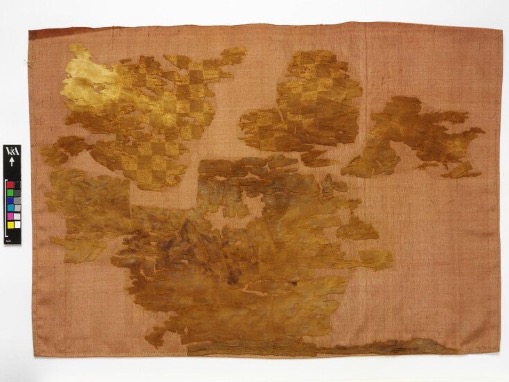
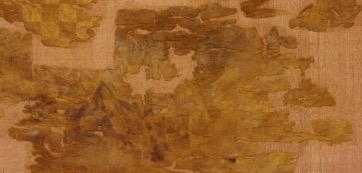
This textile fragment was likely part of a burial shroud and was discovered in Loulan cemetery by Sir Marc Aurel Stein. It was made c.200-400AD from silk – one the main items exchanged in the intertwined trading network of the Silk Road. Silk travelled west from China, while Buddhism spread into China from India via caravans of culture.
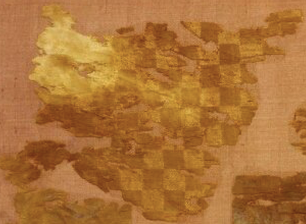
Silk was shrouded in mystery and mythology for many years. As silk production spread to other countries with the establishment of the Silk Road, various origin stories were born to tell the story of how silk was first made. It was also reserved for fine goods and wealthy individuals until the Qing dynasty, making silk a symbol of high status.
Just as this textile is now fragmentary, we can build a vivid picture of the Silk Road from the pieces of history bequeathed to us. Its journey from Loulan to London reflects the many journeys made across the Silk Road and points of exchange along the way. From this, it is possible to create a multi-faceted view of the past and explore its fascinating legacy.
This is one of many items acquired by Sir Marc Aurel Stein (1862-1942), a Hungarian-British archaeologist with a fascination for the ancient world. He made a series of expeditions to China, India, Pakistan, Iran, Iraq and Jordan which he documented extensively. During his lifetime and since, Stein’s ethically questionable collecting practices were criticised, with the Chinese authorities cancelling his passport on one of his trips.
However, as a result of Stein’s and other explorers’ finds being dispersed across the world and now held by institutions such as the National Museum in New Delhi, V&A, British Museum and British Library, studies on the Silk Road have benefitted from international collaboration, leading to greater understanding of its complexity and far-reaching impact.
- https://collections.vam.ac.uk/item/O101601/textile-unknown/ (accessed via Museum Data Service https://museumdata.uk/object-search/object/?pid=36547731-194b-394c-b9e9-86b1f2698c09)
- https://www.britishmuseum.org/collection/china/exploring-silk-roads
- https://www.silkroadtravel.com/silk-road-travel-guide/ancient-city-loulan.html
- https://www.britannica.com/topic/silk
- https://www.britannica.com/art/Chinese-music
-
https://asia-archive.si.edu/podcast/traditional-chinese-music-the-han-tang-ensemble/