
Caravan of Culture - The Buried Vase
In a scorching hot oasis city the air is filled with the growls of camels, as merchants pack more goods into their already overflowing packs, and the hub bub of trade at the bustling market stalls. The heat is intensified by the kilns, the fires within spitting and crackling, firing another batch of green-glazed vases. Potters work tirelessly, scoring patterns into the surfaces of the stout vases, then dipping them into milky white glaze. The damp earthy smell of the fresh clay mingles with the overpowering smell of saffron and nutmeg wafting over from the merchants' stalls, and in his haste the potter leaves a fingerprint in the soft clay as he lifts the vase in to the kiln.
At this time it was the custom to bury the dead with objects. Sometimes people were buried with real objects, but beginning in the Han dynasty, objects were made with the specific purpose to be buried. People were buried with earthenware replicas of things they owned in real life, such as horses, camels, pigsties and sheep folds; as well as figures of people: musicians, dancers and servants.
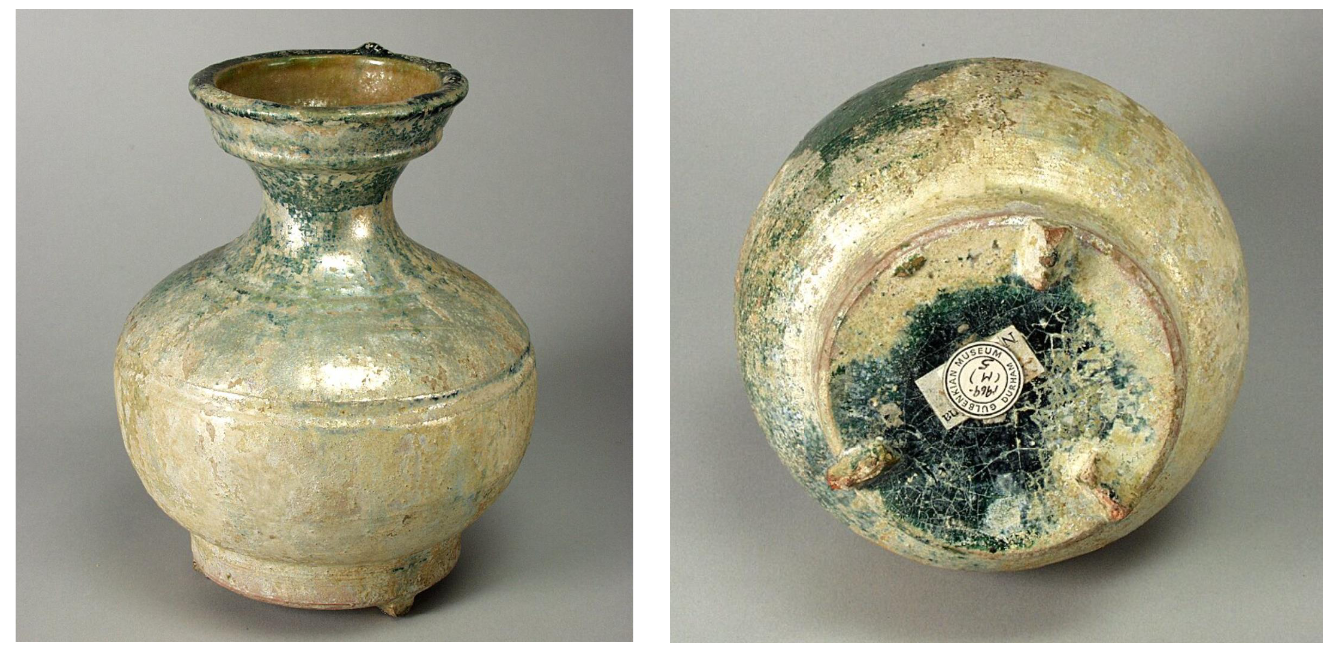
This earthenware vase was created by potters in the Han dynasty in China (202 BCE – 220 CE), with the explicit purpose to be used in a burial. It was made out of a reddish clay and was then glazed with a green lead-fluxed copper glaze. This dark green glaze deteriorated after burial, and its decomposition has left an iridescent sheen over the surface of the vase.
It has been suggested that the green glaze used on earthenware items at this time in China were inspired by green-glazed objects made in the Hellenistic Middle East. The Silk Roads facilitated the transportation of these glazed ceramics from the Middle East to China, allowing this artistic technique to be shared.
You can see on the vase’s base the wedge-shaped stands that are attached to a vase or pot prior to the firing process to prevent it from sticking to the floor of the kiln. These stands have not been removed, potentially because this item was never intended to be used as a vase, just to look like one.
Click here for a multisensory experience of the Buried Vase:
References:
Legeza, I. L., & Macdonald, M. (1972). A descriptive and illustrated catalogue of the Malcolm Macdonald collection of Chinese ceramics, in the Gulbenkian Museum of Oriental Art and Archaeology, School of Oriental Studies, University of Durham.
vases (Earthenware, covered with crazed yellowish green glaze and decorated with carved patterns.). (2062). Oriental Museum, University of Durham.