GERMAN COLONIALISM AND THE COLLECTING OF AFRICAN CULTURAL ASSETS
Historically, German influence and the communities of southern Tanzania have interacted since 1890. This relationship developed against the broader backdrop of European colonial expansion in Africa during the mid-19th century, when European countries increasingly began collecting cultural objects for a variety of purposes. Over time, collecting practices became more systematic, forceful, and alarmingly extensive. This period marked a growing interest in material objects and the ways they shaped - and were shaped by - their relationships with individuals and societies. It also coincided with the emergence of disciplines such as natural history, anthropology, ethnology, and archaeology.
At the same time, museums across Europe actively sought cultural objects from Africa and often communicated lists of desired items to colonial officers, who were expected to acquire the "right" objects for their collections. In the case of ethnographic objects, the German colonial administration implemented specific policies that encouraged and regulated what was termed "ethnographic collecting."The aim was to gather as many supposedly "authentic" objects as possible, particularly from societies believed to have experienced the least cultural “contamination” or change, thereby claiming to preserve them.
As a result, several ethnological museums were established, including the Linden Museum in Stuttgart and the GRASSI Museum in Leipzig. During the height of European colonial expansion in the late 19th and early 20th centuries, large numbers of ethnographic objects were collected from various regions and transported to museums in Europe.
Linden-Museum Stuttgart
Background – The Württemberg Association for Trade Geography

View of the first permanent exhibition of the Linden-Museum Stuttgart. The photograph was taken around 1899. Source: RiffReporter.
The history of the Linden-Museum begins with the founding of the "Württemberg Association for Trade Geography and the Promotion of German Interests Abroad" on February 27, 1882. When the economic crisis hit Germany in the 1870s and domestic markets threatened to collapse, the Association felt compelled to open up new markets overseas. An essential part of the Association was its self-imposed educational mission, which it sought to fulfill through an extensive lecture program. It was not uncommon for these lectures to include the presentation of anthropological objects, as well as colonial and even racial ideologies.
Karl Graf von Linden – Foundation and construction of the Linden-Museum
Karl Graf von Linden (1838 – 1910), a lawyer and later Lord Chamberlain at the Royal Court of Württemberg, took over the chairmanship of the Württemberg Association for Trade Geography in 1889 and advocated an anthropological orientation for the museum, which would collect and document the various cultures as they existed at the time. In line with the widespread belief at the time that the societies referred to as "primitive peoples" would gradually disappear under the influence of European expansion, von Linden saw the central task of the museum as collecting evidence of their material culture and thus preserving it for the future. Count von Linden proceeded with great zeal, and by the time of his death in 1910 he had increased the museum’s collection to over 60,000 objects. He was able to do this only by exploiting the colonial system, which was based on inequalities of power – the actual circumstances of acquisition played only a minor role for him. His contacts provided him with objects from all regions of the world, often without financial consideration.
The Linden-Museum after Karl Graf von Linden
Little is known about the role of the Association during the National Socialist era, and further research is still needed. However, attempts to transform the Linden-Museum into a folklore museum in line with Nazi racial ideology were resisted in 1934. After the Second World War, the museum underwent significant changes. On October 15, 1973, responsibility for the museum was transferred to the state of Baden-Württemberg. In the years leading up to nationalization, numerous objects were sold or exchanged, often through ethnographic art dealers. As a result, former Linden-Museum objects can still be found on the art market today. Since nationalization, the museum has continued to evolve. Redesigned exhibitions on Africa (2019) and Oceania (2022), as well as the special exhibition Difficult Heritage: The Linden-Museum and Württemberg in Colonialism (2021–2022), reflect its ongoing engagement with its own history.
Today, the Linden-Museum emphasizes dialogue, collaboration, and a dynamic understanding of culture. Working together with representatives of source communities, scholars, and the public, it researches the provenance and historical contexts of its collections while developing more participatory approaches to museum work. In doing so, the museum continues to explore what the role of an anthropological museum should be in the future.
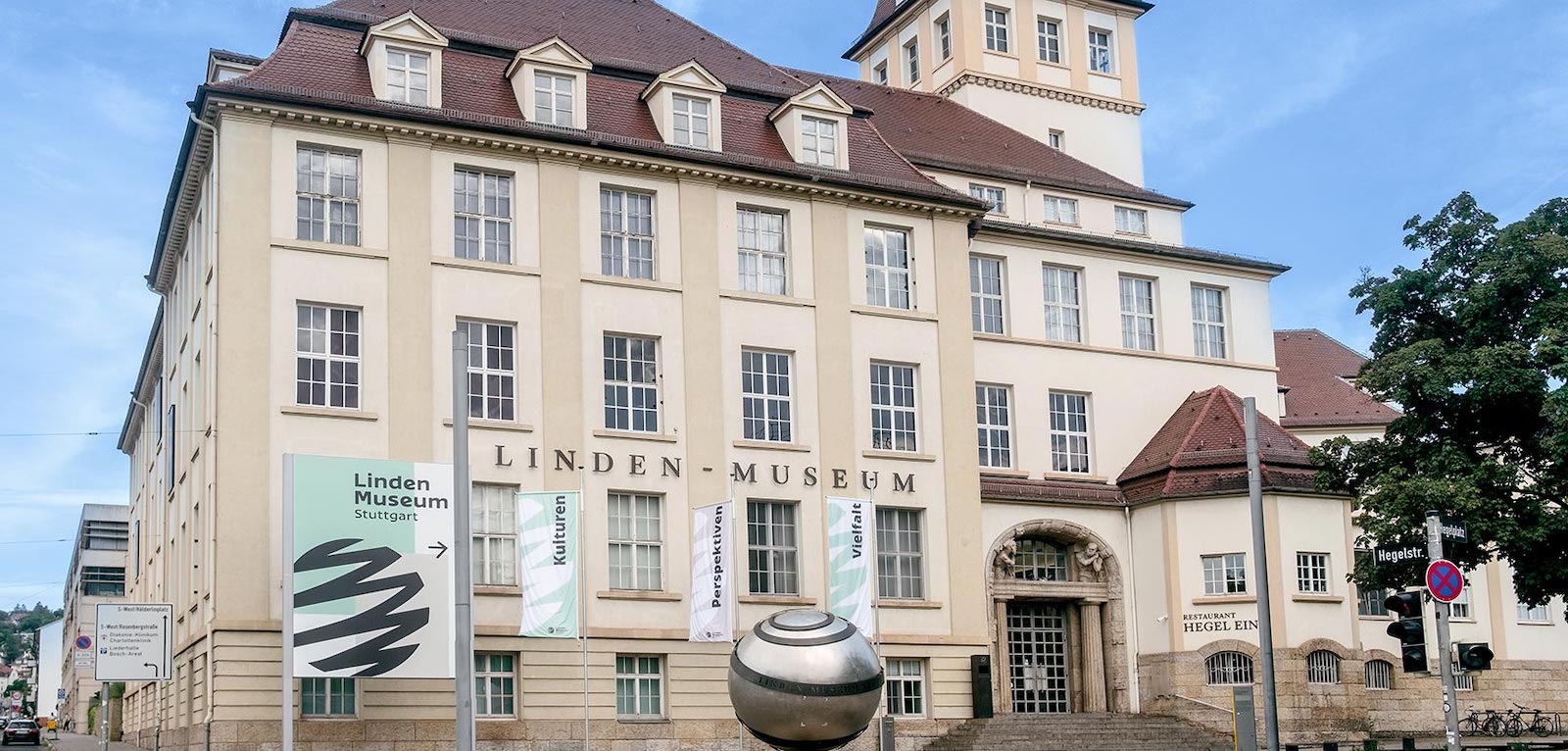
The Linden Museum Stuttgart today. Photograph © Linden Museum Stuttgart / Harald Völkl.
GRASSI-Museum, Leipzig, Saxony
History of the Collection
The Museum of Ethnology in Leipzig was founded in 1869 by citizens of Leipzig. Over the following decades, its collection expanded considerably. During the German colonial period (from 1884 onwards) and under the influence of the later director Karl Weule, who began working at the museum in 1899, the collection grew fivefold. This expansion was made possible through a global network of collectors. One of the most significant donors was the wealthy Leipzig publishing heir Hans Meyer (1858–1929). Objects entered the collection through a variety of means, including research expeditions, missionary activities, military campaigns, private travel, looting, and grave robbery. Since 1927, the Museum of Ethnology has been housed in the GRASSI Museum at Johannisplatz. A bombing raid in 1943 caused severe damage to the building and destroyed approximately one-fifth of the collection.
In recent years, the museum has sought to critically reassess its own history and redefine its role through the REINVENTING.GRASSI.SKD programme, funded by the German Federal Cultural Foundation. Its new permanent exhibition emphasizes global cultural, political, historical, and social connections while addressing contemporary and future-oriented issues.
Maji Maji: War? – German Colonial Loot in Ethnographic Museums
From 1884 the German Empire maintained several colonies in Africa, China, and Oceania. The largest, however, were in Africa: Togo, German Southwest Africa, Cameroon, and German East Africa, which was a colony in the African Great Lakes region that included present-day Burundi, Rwanda, mainland Tanzania, and the Kionga Triangle, a small territory later incorporated into Mozambique. The accompanying political oppression and economic exploitation of the local population were met with resistance in several colonies and eventually led to bloody clashes. In 1904, the Herero and Nama rebelled in German South-West Africa, resulting in the first genocide of the 20th century and killing over 90,000 people.
In July 1905, the so-called Maji-Maji Rebellion in German East Africa followed. This uprising resulted from the introduction of the poll tax, which drove the local population more and more into forced labor and forced them to resettle their plantation areas. One hundred eighty thousand people fell victim to this armed conflict, reducing the population by a third. By comparison, 15 soldiers and 450 askari – African soldiers fighting on the German side – died on the German side.
The Germans confiscated so-called "spoils of war" during this conflict. This was considered state property and was first sent to the central warehouse in Dar es Salaam. The Royal Museum of Ethnology in Berlin was informed of this by the Colonial Department of the Foreign Office.
The Museum then sent Karl Weule, the former director of the Leipzig Museum of Ethnology, who was on a research trip to German East Africa to sift through the spoils of the war. Weule chose 500 arrows, 1300 spears, 100 bows as well as drums and ammunition belts from the collection, which was shipped to Berlin in six boxes. In 1907 he also secured a bundle of war spoils for Leipzig through the Colonial Department. The spears, bows, and shield exhibited here bear witness to the short but intense German colonial rule on the African continent.
Sources
Allsop, Jessica Lauren. Curious Objects and Victorian Collectors: Men, Markets and Museum. Exeter, 2013.
Apoh, Wazi and Andreas Mehler. "Mainstreaming the Discourse on Restitution and Repatriation within African History, Heritage Studies and Political Science" In: Contemporary Journal of African Studies, 7(1), 2020.
De Castro, Inés. "The Linden-Museum of the Future." In: Leonhard Emmerling, Latika Gupta, Luiza Proença, and Memory Biwa (ed), Museum Future. Berlin, 2021.
Dewey, Clare Rachel. Stolen Greek and Roman Antiquities. University of Glasgow, 2001.
GRASSI Museum für Völkerkunde zu Leipzig. "History of the Collection." https://grassi-voelkerkunde.skd.museum/en/about-us/history-of-the-collection/.
GRASSI Museum für Völkerkunde zu Leipzig. "maji maji: war?" https://grassi-voelkerkunde.skd.museum/en/exhibitions/workshop-prologue/maji-maji-war/.
Grimme, Gesa. Provenance Research in the Project "Discomforting Heritag: Dealing with Colonial-Era Objects in Ethnological Museums": Final Report. Stuttgart, 2018.
Grimme, Gesa. "Systemizing Provenance Research on Objects from Colonial Contexts." In: Museum and Society, 18(1), 2020.
Linden Museum Stuttgart. "History." https://lindenmuseum.de/about-us/history/?lang=en.
Mapunda, Bertram B. B. "Voices on Decontextualized Heritage: The Case of Tanzania." In: Marco Tambolini, Michael Ohl, Musa Sadock, Bertram Mapunda, Halfan Magani and Mareike Vennen (ed), Deconstructing Dinosaurs: The History of the German Tendaguru Expedition and its find. Leiden 2024.